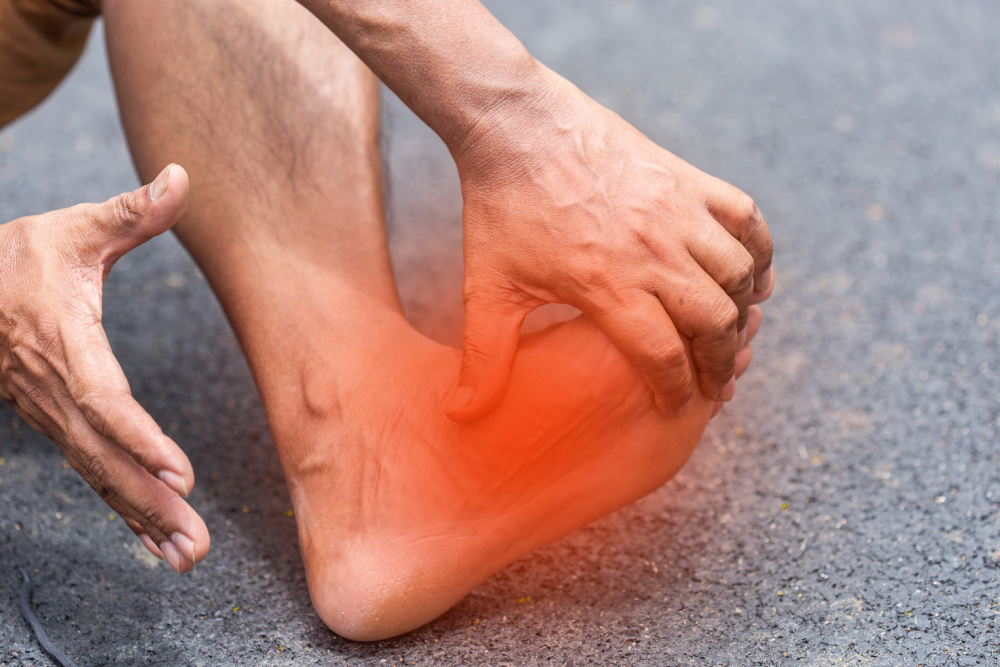
Plantar fasciitis is one of the most common causes of heel pain, and it can be frustratingly persistent.
If you wake up with sharp pain in your heel during your first steps of the day, or you feel stabbing discomfort after sitting for a while, you may be dealing with irritation of the plantar Fascia, the thick band of connective tissue running along the bottom of your foot from the heel bone to the toes. This tissue helps support the arch and absorbs impact during walking and running. When it becomes overloaded, microtears and inflammation can develop, leading to pain that may range from mild annoyance to a significant limitation in daily life.
The good news is that plantar fasciitis responds well to treatment when you address both symptoms and root causes. For many people, the issue is not just the foot itself. Tight calves, limited ankle mobility, unsupportive shoes, prolonged standing, sudden increases in training volume, weight changes, and abnormal gait mechanics can all contribute. That is why a successful plan often involves a combination of home care, activity changes, targeted therapies, and professional support.
Below are 10 widely used treatments for plantar fasciitis, from foundational at-home steps to advanced clinical options. The right combination depends on how long you have had symptoms, how severe they are, and what is driving the problem in your case.
1. Activity Modification and Load Management
One of the most overlooked components of plantar fasciitis recovery is managing the load placed on the plantar Fascia. Many cases begin after a change in activity, like adding more walking, starting a running plan, taking a job that requires long hours on hard floors, or returning to exercise after time off. Even seemingly modest increases can overload tissues that are not accustomed to them.
Load management does not necessarily mean total rest. It means reducing or temporarily avoiding activities that trigger pain, while substituting lower-impact movements that maintain fitness and circulation. Examples include switching from running to cycling, avoiding long walks on concrete, taking breaks if you stand all day, or limiting high-impact classes for a few weeks.
A practical rule many clinicians use is to monitor pain. If a particular activity consistently increases pain during the activity or causes worse pain the next morning, that is a signal to reduce that specific load. When you bring pain down and restore tissue tolerance, you can gradually rebuild activity without triggering flare-ups.
2. Supportive Footwear and Shoe Strategy
Shoes can either protect the plantar Fascia or repeatedly aggravate it. Minimalist, worn-down, or unsupportive shoes often fail to cushion heel impact or stabilize the arch. In contrast, shoes with appropriate arch support, a firm heel counter, and adequate cushioning can reduce strain on the plantar Fascia with every step.
A helpful starting point is to stop walking barefoot on hard surfaces, especially first thing in the morning. Many people notice that their pain is worse when they step out of bed and walk barefoot to the bathroom. Wearing supportive footwear or a supportive house shoe can reduce that initial shock to the heel.
The footwear strategy also includes replacing shoes that have lost their structure. Running shoes and daily walking shoes typically lose support long before they look “broken.” If you are experiencing plantar fasciitis symptoms and your boots are old, replacing them is a simple but often meaningful step.
3. Stretching for the Calves and Plantar Fascia
Stretching is a cornerstone in many cases of plantar fasciitis because tight calves and restricted ankle dorsiflexion can increase tension through the Achilles tendon and into the plantar Fascia. When the calf complex is stiff, the foot may compensate by flattening or overloading the Fascia during gait.
Two targeted stretches are widespread:
Calf stretch with a straight knee to focus on the gastrocnemius. Stand facing a wall, step one foot back, keep the back knee straight, and lean forward until you feel a stretch in the upper calf.
Calf stretch with a bent knee to focus on the soleus. Similar position, but bend the back knee while keeping the heel down, shifting the stretch lower into the calf.
In addition to calf stretching, many people benefit from a plantar fascia-specific stretch. A simple technique is to cross the affected leg over the other knee, grasp the toes, and gently pull them back toward the shin. You may feel a stretch along the arch. This approach can be constructive before your first steps in the morning.
Consistency matters more than intensity. Gentle stretching performed daily, especially after activity and before morning walking, tends to be more effective than occasional aggressive stretching.
4. Strengthening and Foot Intrinsic Training
Stretching alone often is not enough. If the muscles that support the arch are weak or the lower leg is not providing stable control, the plantar Fascia can continue to take excessive load. Strengthening is the “structure” side of recovery. It improves the distribution of forces through the foot and ankle.
Common strengthening targets include:
The foot intrinsic muscles that support the arch. Exercises like short foot, where you gently draw the ball of the foot toward the heel without curling the toes, help retrain arch control.
Calf strength, especially eccentric loading. Slowly lowering the heel off a step can improve tendon capacity and reduce strain patterns.
Hip and glute strength, which influences gait mechanics and how the foot strikes the ground.
A balanced strengthening plan is typically progressive. You start with low-intensity control work, then build into more load-bearing exercises as pain decreases. The goal is to improve the foot’s ability to tolerate everyday demands, not to chase soreness.
5. Ice, Heat, and Anti-Inflammatory Approaches
Symptom management is not the whole solution, but it is helpful during flare-ups. Ice can reduce pain and calm irritation, particularly after a long day on your feet. A classic approach is rolling the foot over a frozen water bottle for several minutes. This combines cold therapy with gentle massage.
Heat may be helpful before stretching or movement if the foot feels stiff. Some people respond better to heat in the morning and ice later in the day. The best approach is the one that reduces your pain and helps you stay consistent with rehab.
Over-the-counter anti-inflammatory medications may help some individuals, but they should be used with appropriate medical guidance, especially if you have other health conditions or take other medications. It is also worth noting that plantar fasciitis can become more degenerative than purely inflammatory in chronic cases, so the long-term answer usually involves improving tissue capacity and mechanics rather than relying on anti-inflammatories.
6. Massage and Myofascial Release Techniques
Manual techniques can be effective for reducing pain and improving tissue mobility. This may include gentle massage along the arch, calf muscle release, and work around the Achilles and ankle. Tightness in the calf and tissues under the foot can increase the pulling forces on the plantar Fascia, so soft-tissue work often complements stretching and strengthening.
At home, a tennis ball or lacrosse ball can be used to roll the arch. Pressure should be tolerable. The goal is to reduce stiffness, not to bruise the tissues. A short daily routine can make the foot feel better, especially when paired with a structured rehab plan.
Clinically, soft tissue therapy performed by a qualified provider can be more targeted and may address related restrictions higher up the kinetic chain, such as the calf, peroneals, or posterior tibial muscles that influence foot mechanics.
7. Taping and Temporary Arch Support
Taping is a practical short-term intervention that can provide immediate relief by supporting the arch and reducing strain on the plantar Fascia. Athletic taping methods can alter how forces are transmitted across the foot during walking, often reducing that sharp heel pain.
Taping is not a long-term fix, but it can be beneficial in the early stages. It may allow you to stay active, continue working, or participate in rehab exercises with less pain. Some people use taping during work shifts or long days on their feet to build strength and address underlying issues.
Another temporary support option includes over-the-counter arch supports, which can help distribute pressure. The key is to treat these as tools that enable healing, not as the only strategy.
8. Night Splints for Morning Heel Pain
The classic morning pain of plantar fasciitis often relates to the plantar Fascia tightening overnight. When you sleep, your foot may rest in a pointed position, allowing the Fascia and calf to shorten. The first steps in the morning can then abruptly re-stretch the tissue, causing sharp pain.
Night splints help by maintaining the ankle in a more neutral position, keeping the plantar Fascia gently lengthened. This can reduce the severity of morning pain and may help the tissue heal over time.
Night splints are not always comfortable at first, and not everyone tolerates them well. But for people with pronounced first-step pain, they can be a valuable addition. If you try one, aim for gradual adaptation, starting with shorter wear times.
9. Physical Therapy and Professional Rehab Programs
A structured physical therapy program can make a significant difference, especially if your symptoms have lasted longer than a few weeks, you have recurring flare-ups, or you are not sure what is driving the problem. Physical therapy is beneficial because it combines assessment with individualized care. A clinician can evaluate ankle mobility, foot mechanics, gait, calf tightness, strength deficits, and contributing factors like hip stability.
Treatment may include manual therapy, progressive strengthening, balance training, gait retraining, and education on footwear and activity management. The real advantage is the progression. Many people attempt a few stretches, feel mild improvement, then stall because they miss the next step: progressively loading the tissues so they become resilient again.
When plantar fasciitis is persistent, professional rehab can also help rule out other conditions that can mimic it, such as nerve entrapment, fat pad irritation, stress injury, or referred pain patterns.
10. Chiropractic Care and Advanced Non-Surgical Therapies
For many individuals, plantar fasciitis is not only a local foot problem but a movement system problem. When the joints of the foot and ankle are not moving well, or when the kinetic chain mechanics are altered, the plantar Fascia can be forced to absorb more load than it should. Chiropractic care can play a helpful role by addressing mobility restrictions and mechanical contributors, while integrating rehabilitation and soft-tissue therapy.
Depending on the clinic and the provider’s scope and training, chiropractic-based plantar fasciitis care may include:
Assessment of foot and ankle joint motion, gait mechanics, and posture. Manual therapies aim to restore mobility in the foot, ankle, and, sometimes, the knee and hip. Soft tissue work for the calf, Achilles, and plantar fascia to reduce tension patterns. Corrective exercise programs focus on strengthening, flexibility, and stability.
Guidance on footwear, orthotics when needed, and activity modifications.
Additionally, many modern clinics offer advanced, non-surgical modalities that may support recovery in stubborn cases. These can include therapeutic ultrasound, laser therapy, and other regenerative-oriented approaches designed to reduce pain and encourage tissue repair. While not every case requires advanced modalities, they may be appropriate when conservative care has not fully resolved symptoms.
The value here is an integrated plan that relieves pain, restores motion, strengthens the system, and reduces the risk of recurrence.
Putting It All Together: A Practical Treatment Strategy
Because plantar fasciitis is multi-factor driven, the most effective plan is often layered:
Start by reducing aggravating activities, upgrading footwear, and adding gentle stretching.
Add taping or temporary arch support to reduce pain and improve function.
Progress into strengthening the foot, calves, and hips. Use symptom management, like ice after heavy days. If morning pain is severe, consider night splints.
If progress is slow after several weeks, pursue a professional evaluation to identify what is being missed.
For many people, the difference between lingering pain and steady improvement is not a single “magic” treatment. It is selecting the right combination and following a progression that builds tissue capacity over time.
Conclusion: The Best Path Forward in Orange County, CA
Plantar fasciitis can be stubborn, but it is highly treatable when you address both short-term pain control and the deeper mechanical and functional causes. The most successful outcomes typically come from a comprehensive approach that improves foot and ankle mobility, reduces overload on the plantar Fascia, strengthens the supporting muscles, and corrects the movement patterns that perpetuate the condition.
If you are looking for a results-driven, non-surgical approach to heel pain, Khorrami Chiropractic Wellness Center stands out as the best plantar fasciitis treatment center in Orange County, CA. Our focus on identifying the root cause, combined with hands-on care and structured rehabilitation strategies, gives patients a clear plan to reduce pain, restore function, and return to regular activity with confidence.